EnglishSlovenia

+386 (0) 8 20 59 630

tajnistvo@cukrov.eu

Law firm Cukrov

Tivolska cesta 48, 1000 Ljubljana

Co-authors of the Chambers Global Practice Guides 2026.
In 2025 alone, we achieved four landmark victories at the Constitutional Court of Slovenia.

News

Vesna Cukrov for Delo on legal protection regarding NRC’s decisions

You are cordially invited to read today’s conversation in the newspaper Delo with Samo Červek, President of the National Review Commission, and Vesna Cukrov, attorney at law, court expert for law and public procurement and former President of the National Review Commission, on the topic of legal protection regarding NRC’s decisions. Link to article: https://www.delo.si/gospodarstvo/novice/o-drugem-tiru-in-e-vinjetah-morda-tudi-upravno-sodisce/



PRO BONO DAY OF LEGAL AID

Same as every year, Law firm Cukrov is participating in the charitable day of free legal aid, which will be on 19.12.2020. Anyone requiring pro bono legal advice can contact us on tajnistvo@cukrov.eu on this day.

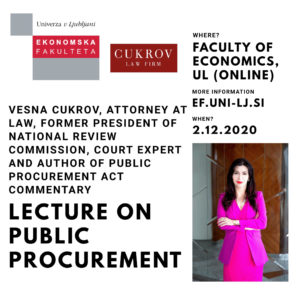
LECTURE OF VESNA CUKROV AT FACULTY OF ECONOMICS

Vesna Cukrov, attorney at law, former president of the National Review Commission, court expert for law and public procurement and co-author of the ZJN-3 (Slovene public procurement act) commentary will give a lecture at the Faculty of Economics, University of Ljubljana on 2 December 2020 on how both contracting authorities and tenderers can perform effective public procurement procedures, even in the current situation. More information: http://www.ef.uni-lj.si/ 

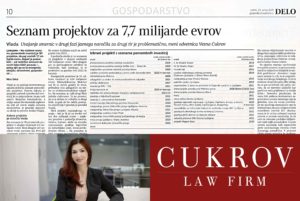
VESNA CUKROV FOR NATIONAL JOURNAL DELO ON 7.7 BILLION EUROS OF WORTH STATE INVESTMENTS

The newspaper Delo had a conversation with an attorney, the former president of the National Review Commission and a court expert for law – public procurement Vesna Cukrov regarding the 7.7 billion euros worth of investments that Slovenia is currently heading into. The key points of the article are the relationship between state sovereignty in public procurement and between EU rules, as well as the issue of public interest, which sometimes interferes with the principle of free competition. You are kindly invited to read the article yourself: https://lnkd.in/eu-mfAX


SECOND AMERICAN CIVIL WAR: an article by Veronika Cukrov on police brutality

The following is a translation of an article by our colleague Veronika Cukrov, Master of Laws and PhD candidate, which was originally published in Svet Kapitala: https://svetkapitala.delo.si/mnenja/veronika-cukrov-druga-ameriska-drzavljanska-vojna/

SECOND AMERICAN CIVIL WAR 

If we listen to the message of the current protests, they seem to focus on the death of George Floyd, an African-American who was strangled to death by Officer Chauvin during police detention. Despite this horrific event, the answer to the question of why this very event drove the US into a civil war is not so simple.

Statistical anomaly or established practice?

The statistical website mappingpoliceviolence.com reports that black people accounted for 24 percent of police killings in 2019, with black people accounting for only 13 percent of the total population; black people are thus above-averagely represented as victims of police violence, which is supposed to confirm the thesis of institutionalized violence. Also, black people are said to be 1.3 times more often unarmed than other races; 99 percent of the cases of people killed by the police did not end in a police officer’s accusation, let alone a conviction.

In 2019 alone, U.S. police killed 1,099 people, a problem that has been dragging on not just for years, but for decades. For example, a comprehensive U.S. Department of Justice report on the use of force in the police, published in 2001, found that as early as 1999, approximately 422,000 people aged 16 and over had contact with police in which force or threat of force was used.

Despite these extensive statistics, protesters only shout Floyd’s name, and not just because the event was filmed by several eyewitness cameras, cameras from neighbouring stores and broadcast on social networks (which we have already experienced several times).

Floyd’s murder is shocking primarily because it portrays violence as a conscious, ongoing, and organized decision; four (i.e. all present) police officers were more or less actively involved in the more than 9-minute strangulation of the “suspect” (who allegedly bought cigarettes with a counterfeit banknote, which was not proven), despite 16 (!) intermitten statements by Floyd that he cannot breathe, and despite the constant requests of eyewitnesses that the police check his pulse and stop choking him.

After a long strangulation, the seemingly completely unaffected police officers, together with the rescuers, loaded Floyd’s immobile body on a stretcher and drove away as if it were something most mundane.

Pressing the trigger of a gun (which is the result of most deceased victims of police violence) is an instantaneous, often even subconscious decision, which can be much easier to defend than a justified or at least justifiable move, and that is why firearms are so dangerous.

Strangling an individual for 9 minutes is something completely different. The involvement of all police officers present in Floyd’s murder (two of the police officers involved had previously been involved in several cases of violence, including cases of shooting at unarmed minorities) is what is most frightening in Floyd’s case; in the United States it is very popular to point out that police violence is a pair of bad eggs among police officers, and not a systemically widespread practice that would be approved within the police.

The mere fact that Chauvin and Thao (two police officers in Floyd’s case) kept their jobs after previous cases of violence, and that all police officers on the scene, in an almost “zombie” trance, took part in the murder, seems to the protesters proof of the thesis that violence is woven into the very structure of the American police system.

This case, of course, reminded Americans of many past notorious cases of police violence; from the case of Tamir Rice, a child who played with a toy in the shape of a gun and was shot without even being asked to drop the toy; through cases of black people holding Skittles candies (which would be perceived by the police as a gun); to individuals who went running (which the police perceived as threatening to do); or persons wearing a hood (very suspicious acts themselves!); and all the way to the case of Sandra Bland, a black woman who ended up in custody immediately for a traffic offence and allegedly hanged herself there a few days later.

After Floyd’s assassination, the American public no longer perceived these cases as sporadic or localized deviations, but as an expression of the organized practice of the entire police force.

A similar excuse for the described actions of the police officers, such as the one regarding the “pair of rotten eggs among the police officers”, is also the excuse that the police officers were simply afraid; in a country with a widespread practice of carrying weapons, this is a fairly acceptable reason, with current protests unfortunately further increasing the sale of firearms to private individuals.

With the “fear” of the police, it was always possible to “justify” at least part of the killings and to some extent calm the majority of the public. That is no longer enough now; Floyd posed no threat to anyone – not to third parties, not to the police. He did not physically resist detention, and if anyone was afraid, it was only him. None of the other officers also demanded that Officer Chauvin remove his knee from Floyd’s neck; one police officer only harassed an eyewitness to stop recording their conduct.

What the other side says

Statistics undoubtedly show that black people are more frequent victims of violence in the U.S., but there are still plenty of cases of whites being killed by the police entirely through no fault of their own. Personally, I think this is a problem of too strong a repressive apparatus, which, due to the personal beliefs of individual police officers, more often manifests itself against black people; at its core, therefore, it is primarily a systemic problem of excessive police repression and not necessarily a systemic problem of racism, even though the protests focused entirely on the latter.

There are even Americans who advocate the fact that the police are more likely to intimidate and carry out illicit practices on black people; namely, they support the practice of racial profiling with an emphasis on the crime control model. As black people are more likely to be perpetrators of certain crimes, it allegedly makes sense for the police to behave “preventively” and more severely towards them on the basis of these statistics.

Trump likes to say that Floyd’s death was not “in vain” as the perpetrators will be punished; the protesters, on the other hand, argue that such a death is nevertheless in vain, and that even a fair trial cannot justify it. At the same time, Trump himself is fomenting unrest by urging police and the military to be relentless in fighting riots, which only adds to the protesters’ claim that the United States is an inherently brutal country.

How about possible solutions?

Many proposals have been made in the past to prevent police brutality. One of the proposed and already used solutions are body cameras on police officers; these are supposed to make sure that police officers commit fewer offences as they know their actions are being recorded. These cameras have been in use in the U.S. for quite a few years and interestingly, they were also worn by police officers in the George Floyd case, however, this did not deter them from brutal treatment.

Undoubtedly, part of the problem stems from the general police powers, which, however, originate from the sphere of law itself, especially from case law. The Terry stop or Stop and Frisk doctrine, for example, allows the police to detain a person on reasonable suspicion of involvement in criminal activity. It is a very low standard of suspicion, much lower than that required for arrest or detention.

This doctrine allows the police to forcibly detain an individual who has most likely done nothing, and in the meantime, the police know how to do many things with him. “Terry stop” originates from a decision of the Supreme Court from 1968 (Terry v. Ohio); in this case, police suspected a pair of African-Americans of committing a robbery, investigated them solely for this purpose, and found some weapons in the process, and this resulted in their prison sentences. The Supreme Court ruled 8 to 1 that the conduct of the police was appropriate.

Undoubtedly, the very change of such legal rules, from the powers of the police to the justified reasons for detention, could change the statistics of police violence.

In conclusion

As a lawyer, I must, in principle, condemn any violence, and there has been a great deal of this in these protests, both by the authorities and by the protesters. Some of the protesters are advocating violence against police officers and the destruction of private property as they see the current riots as another French revolution and thus legitimize their violence.

To some extent, I understand this, as it is difficult to achieve anything in the American democratic process; the very idea of ​​a two-party presidential system means that protesters in the upcoming election have a choice between Trump, whom he called “thugs” (a highly racially reprehensible term), and Biden, who told his black interviewee last week that “if he doesn’t vote for him, he’s not black.”

The situation saddens me, but at the same time it is a very logical conclusion to half-past American history. And although one side emphasizes only the brutality of the repressive police apparatus and the other only the damage done by the protesters, above all I hope to find a connecting figure who manages to end the violence on both sides.

The fact is that if the rule of law fails at the level of police violence, it will undoubtedly also fail in its efforts for peaceful democratic processes.

-Veronika Cukrov

PhD CANDIDATE IN ENERGY LAW AND OUR COLLEAGUE VERONIKA CUKROV WRITES REGARDING POLLUTER PAYS PRINCIPLE

A PhD candidate in Energy Law and a lawyer who regularly works in this field, our colleague Veronika Cukrov, wrote for the TFL Gazette “Does the polluter really pay? An example of a European Clean Energy for All Europeans package” that deals with the eternal the question of who is responsible for environmental damage, how to articulate property rights in a way that allows clear accountability for emissions, and whether new European legislation in this field is introducing drastic changes. You are welcome to read the article on the following link: https://lnkd.in/g8nXj_6


ATTORNEY VESNA CUKROV AT 21ST PROCUREMENT DAYS CONFERENCE

Attorney at law, a law and public procurement court expert and a former president of the National Review Commission, Vesna Cukrov, will give a lecture at the traditional 21st Procurement Days conference of the Management Agency and the Public Procurement Association in March, where she, alongside other experts, will answer the question “How to successfully remedy anomalies in the procurement process? “. You are cordially invited to attend the event yourself, thus deepening your knowledge of practicing public procurement! The program and applications are available at the following link: https://agencija-management.si/Aktualni-Program

INTERNATIONAL FRAUD AWARENESS WEEK: LEGAL EXPERT VESNA CUKROV WILL PARTICIPATE AT A ROUND TABLE DEBATE

In the week of 17.-23. November of 2019, the ACFE is organizing their annual International fraud awareness week, which is seeking to minimize the effect of fraud on the economy and our lives, and joins hundreds of organizations and experts in our joint effort to combat this issue. This year, on 22. of November, Vesna Cukrov will be sharing her broad legal experience on this issue by participating in a round table debate.

GLOBAL INFRASTRUCTURE DIALOGUE 2019 IN FRANKFURT

Law Firm Cukrov attended this year’s Global Infrastructure Dialogue 2019 between 26th and 27th of June in Frankfurt! It is important for us to keep up with the latest infrastructural trends and find the most innovative legal solutions for our clients in this field. Frankfurt is also rumored as the next financial capital after Brexit; besides being the city of ECB, Frankfurt is the home of many big banks and a decision maker for many of our monetary and surprisingly even fiscal policies of the EU. In the beginning of the year, around 800 bn € were transferred from London to Frankfurt, despite the latter only having around 750.000 registered citizens!

Learn more:

https://lnkd.in/dym2MZG

https://lnkd.in/dhKes4B

EnglishSlovenia

Constitutional law

Here, more is decided than the individual case. The ruling sets the standard by which all later cases will be judged.

We represent clients in precedent-setting constitutional matters that influence the development of the standards of legal judgment.

This is a field of rare cases with the widest reach, where a decision extends beyond the client and shapes the law going forward.

In 2025, the Constitutional Court published four landmark decisions in our clients' favour, finding municipal spatial plans unconstitutional and significantly strengthening the protection of private property against arbitrary interference by municipalities and the state, in the cases of SDH (U-I-265/22), Mercator (U-I-218/22), Roltek (U-I-268/22) and Rovanova (U-I-269/22).

Four decisions in a single year – at the highest level of judicial review.

EU law

More and more of the rules that matter to Slovenian companies are made not in Ljubljana, but in Brussels and Luxembourg. And we know how to act there.

We advise and represent clients in matters with an EU-law dimension, from the interpretation of directives and regulations to proceedings before the European Commission and the Court of Justice of the European Union.

For us, European law is not a distant framework but the working environment in which we actually operate.

The field is led by Veronika Cukrov, who pursued further studies in European law at the Academy of European Law (ERA) and, as part of a wider team, took part in an action before the Court of Justice of the EU.

An understanding of EU law connects all our practice areas, from public procurement and competition to artificial intelligence.

Regulation and the Competition Protection Agency (AVK)

The market has its own rules and its own guardian. Those who understand both are never caught off guard when it matters most.

We conduct regulatory proceedings across various fields and advise on competition law and on matters with an impact on the market, including allegations of cartel conduct and questions of exposure to competition.

Our track record speaks for itself.

In the matter of alleged cartel conduct in the construction of UKC Maribor, we secured the annulment of the AVK's decision before the Administrative Court, after which the Agency discontinued the proceedings.

For Slovenske železnice – Tovorni promet we successfully conducted a procedure in which the AVK found that rail freight transport in Slovenia is directly exposed to competition.

We pursued the matter all the way to the European Commission and the Court of Justice of the EU.

Healthcare

Healthcare is one of the most heavily regulated systems in the country, and one in which legal decisions have a direct impact on people.

We address systemic questions of healthcare, regulation and the organisation of health services, including relations with the sector's regulators and agencies.

We work on matters involving the sector's key regulators, including JAZMP, the Agency for Medicinal Products and Medical Devices.

We understand healthcare as a system, not as a series of separate cases.

Energy

Energy is not merely an industry. It is critical infrastructure on which the functioning of the state depends.

We advise on regulation, energy systems and critical infrastructure, where legal questions intertwine with the public interest, security of supply and long-term investment cycles.

We know the sector from the inside: Vesna Cukrov served on the supervisory board of Holding Slovenske elektrarne, one of the largest companies in the country – as a member, deputy chair and chair.

Veronika Cukrov is also a PhD candidate in energy law.

We do not advise the energy sector from the outside, but with an understanding of how such a system actually works and makes decisions.

Vesna Cukrov, public procurement lawyer and former President of the National Review Commission (DKOM)

Infrastructure and investment

Projects of national importance leave no room for improvisation. Every mistake costs years and millions.

We specialise in infrastructure, investment delivery and construction, acting for both contracting authorities and bidders.

We advise contracting authorities at every stage of investment preparation: from land acquisition, building permits and project documentation to contract drafting, with one aim: to prevent disputes before they arise.

We help bidders win contracts, prepare and review contracts, and protect their interests.

Where a dispute cannot be prevented, we represent clients in court proceedings and in claims for damages.

We have been involved in most major infrastructure investments in Slovenia, including projects of national importance on the largest scale.

These are environments where law, economics and the public interest are interwoven.

Advising supervisory and management boards

Decisions at the top cannot be undone.

We provide management and supervisory boards with dedicated strategic legal advice on decisions involving significant responsibility and long-term consequences for the company.

We understand board members' responsibility, risk assessment and the weight of a resolution from first-hand experience, not only from the law that governs them.

This field is led by Vesna Cukrov, who served a full term on the supervisory board of Holding Slovenske elektrarne – as a member, deputy chair and chair – and who holds a certificate of qualification for members of management and supervisory boards.

The advice you receive comes from someone who has sat in that chair, not from theory.

Vesna Cukrov, public procurement lawyer and former President of the National Review Commission (DKOM)

AI and European regulation

Artificial intelligence does not wait for the law to catch up. We anticipate where the law is heading.

We lay the legal foundations for the responsible and compliant adoption of artificial intelligence within the framework of European regulation, from risk assessment and AI governance to the implementation of the AI Act in everyday business practice.

The field is led by Veronika Cukrov, recognised by Leaders in Law in 2026 as AI Expert of the Year in Slovenia & the EU, for her work at exactly this intersection of artificial intelligence, its governance and European regulation.

She speaks regularly on these questions at home and across Europe, in the forums where European law is still being shaped.

We do not just help clients comply with yesterday’s rules. We show them where regulation is heading.

Veronika Cukrov, public procurement and artificial intelligence (AI) legal expert, Law Firm Cukrov
AI Expert of the Year in Slovenia & the EU

National Review Commission (DKOM), public procurement and concessions

Public procurement is a discipline in which every detail can be decisive, and successful representation in minor-offence proceedings calls for highly specialised expertise.

Vesna Cukrov chaired the National Review Commission, is the co-author of the commentary on the Public Procurement Act (ZJN-3), published in 2016 by Tax-Fin-Lex, and is a court-appointed expert in law and public procurement.

For this field, Odvetniška družba Cukrov received recognition from the international organisation Leaders in Law in 2021 and 2025: "Global Awards winner" and "Public Procurement Expert of the Year in Slovenia".

We represent both bidders and contracting authorities at every stage of public procurement and concession-award procedures: in preparing tender documentation and bids, in negotiations and the conclusion of contracts, in requests for review and legal opinions in complex cases, and in proceedings before the National Review Commission.

We are particularly successful in minor-offence proceedings in this field and in defending against allegations of criminal fraud affecting the EU's financial interests.

We do not just read the commentaries on public procurement law. We helped write them.

Vesna Cukrov, public procurement lawyer and former President of the National Review Commission (DKOM)